THE DIMENSIONS OF WEALTH
What If Being Rich Is More Than Having Money?
For a long time, I thought wealth was primarily about having money. Like many people, I associated wealth with the things that could be seen: a beautiful house, a good car, a successful business, land, investments, a healthy bank account and the ability to afford what you want without constantly worrying about the price. There is nothing wrong with wanting these things. Financial wealth matters. But my journey has taught me something I did not fully understand when I started building businesses: Money is only one dimension of wealth. And perhaps one of the greatest mistakes we make is becoming wealthy in one dimension while remaining dangerously poor in another. The Bible actually gives us several examples of this.
Solomon had extraordinary wealth and wisdom. Joseph demonstrated exceptional administrative intelligence and leadership. Job lost almost everything materially but did not lose his identity. The rich fool accumulated tremendous possessions but failed to understand the purpose of his life. So perhaps the question is not simply:
“How much do you have?”
Perhaps the better question is:
“How wealthy have you become in the dimensions that actually make life valuable?”
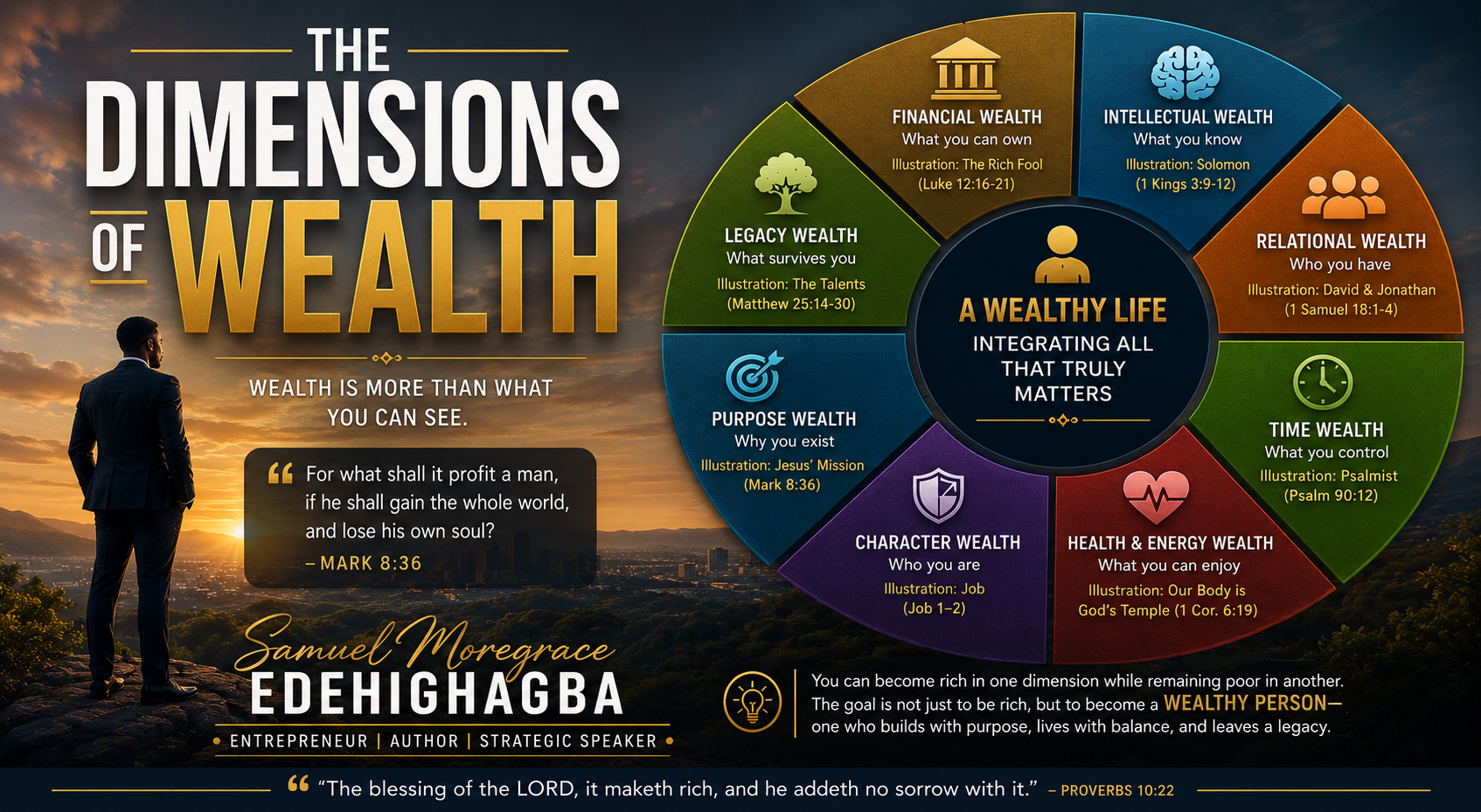
1. FINANCIAL WEALTH: WHAT YOU CAN OWN
This is the dimension we understand most easily. Financial wealth includes money, businesses, investments, real estate, cash flow and assets. As a real estate entrepreneur, I understand the attraction of tangible assets. There is something powerful about taking a piece of land and transforming it into something that people can live in, invest in and eventually pass to another generation. But entrepreneurship has taught me something important:
Owning assets is not necessarily the same thing as being wealthy.
You can own property and still struggle with cash flow. You can have a valuable business and still have no liquidity. You can have assets on paper and still be under enormous financial pressure. The Bible gives us perhaps one of the strongest warnings about confusing accumulation with wealth in the story of the rich fool.
Jesus tells the story in Luke 12:16–21 of a man whose land produced abundantly. His solution was to build bigger barns, store more goods and tell himself that he had enough to relax and enjoy life. But God called him a fool.
Why?
Not because he had possessions. But because his possessions had become the measure and purpose of his life.
Jesus concluded:
“So is he that layeth up treasure for himself, and is not rich toward God.”
— Luke 12:21
That is a powerful distinction. There is a difference between having wealth and being rich in the things that matter to God.
Money matters. But money alone is not wealth. It is one dimension of wealth.
2. INTELLECTUAL WEALTH: WHAT YOU KNOW
One of the greatest changes in my own journey has not simply been what I have accumulated. It has been what I have learned. Entrepreneurship forced me to learn things I never expected to learn. Real estate taught me about land, construction, valuation, development and risk.
Business taught me about people, systems, cash flow, leadership and decision-making. Setbacks taught me discernment. Failure taught me humility. Pressure taught me that knowledge without application is simply information. This is one of the reasons I created The CEO Perspective.
I realized that some of the most valuable things I was gaining were not physical assets. They were lessons. The ability to think differently. The ability to question assumptions. The ability to identify patterns. The ability to make decisions under pressure. The ability to learn from mistakes instead of allowing mistakes to define me.
The Bible says:
“Wisdom is the principal thing; therefore get wisdom: and with all thy getting get understanding.”
— Proverbs 4:7
Consider Solomon. He could have asked God for riches, long life or victory over his enemies. Instead, he asked for wisdom to govern. And God gave him wisdom and also wealth. This teaches us something important:
Sometimes the most valuable thing you can acquire is not the wealth itself, but the capacity to manage the wealth.
Hence why i never prayed for wealth but the wisdom to handle, sustain and grow them because i understand that, money can disappear. But intellectual wealth gives you the ability to learn, adapt, solve problems and create value again.
3. RELATIONAL WEALTH: WHO YOU HAVE
There was a time when I thought networking was primarily about meeting people.
I no longer see it that way.
I have learned that relational wealth is not the number of people who know your name. It is the quality of people you can build with, trust and serve.
Entrepreneurship has shown me both sides of relationships. I have experienced betrayal. I have also experienced people who genuinely believed in what I was building. That contrast taught me something important:
Not every relationship is an asset, and not every connection deserves access to your vision.
The Bible says:
“Two are better than one; because they have a good reward for their labour.”
— Ecclesiastes 4:9
Why?
Because life was never designed to be built entirely alone.
Look at David.
His relationship with Jonathan became one of the most significant relationships in his journey. Jonathan's friendship did not simply make David feel good; it strengthened him during a dangerous season.
Look at Paul.
His ministry was filled with people who travelled, served, suffered and built alongside him. And look at Jesus.
Even though He could have accomplished His earthly mission without needing human companionship, He intentionally built relationships with people.
This is why I increasingly believe that your network should not merely be a list of contacts. It should be a community of people with whom value can be exchanged and purpose can be advanced.
Relational wealth is not only about what people can do for you. It is also about what kind of person you are to others.
4. TIME WEALTH: WHAT YOU CONTROL
This is one dimension of wealth that entrepreneurs often overlook. We spend years trying to make money so that one day we can have freedom. But sometimes, in the process of building the money, we give away the very freedom we were trying to buy. I have had seasons where the business demanded almost everything from me.
There is always another project.
Another problem.
Another payment.
Another decision.
Another person who needs your attention. Another opportunity that seems too important to ignore. And eventually you begin to ask:
Am I building a business that gives me freedom, or have I simply created a more sophisticated form of employment for myself?
That question matters.
Because time is an asset you cannot replenish.
The Bible says:
“So teach us to number our days, that we may apply our hearts unto wisdom.”
— Psalm 90:12
Notice the language. It does not simply say count your money.
It says number your days. Your life is being spent whether you are intentional about it or not. You can make more money. You can acquire another property. You can rebuild a business. But you cannot buy yesterday back.
Time wealth is having the wisdom and systems to use your limited time for what matters most.
5. HEALTH AND ENERGY WEALTH: WHAT YOU CAN ENJOY
What is the value of building a ₵10 million empire if your body cannot carry you into the future you are building? Entrepreneurs often celebrate exhaustion.
We glorify being busy.
We say:
“I don't sleep; I am building.”
But exhaustion is not always evidence of progress. Sometimes it is evidence that your system is broken.
The Bible says:
“Know ye not that your body is the temple of the Holy Ghost...”
— 1 Corinthians 6:19
Whether you approach this from a spiritual or practical perspective, the principle is powerful:
You have a responsibility to steward the vessel through which you carry your assignment.
Your body needs rest. Your mind needs clarity. Your emotions need stability. Your relationships need your presence. Because eventually, the person building the wealth must also be capable of enjoying what has been built.
A wealthy life cannot be built by destroying the vessel carrying it.
6. CHARACTER WEALTH: WHO YOU ARE
This may be one of the most important dimensions of wealth. And perhaps one of the least discussed. Character is what remains when nobody is watching.
Integrity.
Discipline.
Courage.
Responsibility.
Self-control.
Faithfulness.
The ability to keep your word. My journey has taught me that business does not create character.
Business reveals character.
Pressure reveals it. Money reveals it. Power reveals it. Failure reveals it. Success reveals it. When things are going well, almost anyone can appear disciplined.
The real question is:
Who are you when things don't go according to plan?
Consider Job.
In one season, he had tremendous material wealth. Then almost everything collapsed. His possessions were destroyed. His children died. His health deteriorated. His relationships became strained. Yet there was something deeper than his possessions that remained. His character. His relationship with God. His identity. That story challenges us to ask:
If everything you own disappeared, what would remain of you?
Proverbs 22:1 says:
“A good name is rather to be chosen than great riches.”
Think about that. The Bible places reputation and character in a category that can be more valuable than material wealth. The entrepreneur who cannot control himself will eventually struggle to control his business. The person who sacrifices integrity to gain wealth may eventually discover that the wealth they gained cannot buy back their credibility.
Character is the container in which other forms of wealth must be stored.
7. PURPOSE WEALTH: WHY ARE YOU BUILDING?
This question has become increasingly important to me.
Why am I building? Why real estate? Why entrepreneurship?
Why write?
Why create The CEO Perspective?
Why keep going when the journey becomes difficult? Because if the only answer is money, eventually the journey becomes empty. Jesus asked a question that remains one of the most powerful questions in Scripture:
“For what shall it profit a man, if he shall gain the whole world, and lose his own soul?”
— Mark 8:36
Think about the economics of that question.
Gain the whole world.
Not a house. Not a business. Not a few million. The whole world. And yet Jesus says there can still be a catastrophic loss. That means acquisition is not the same thing as fulfillment. There were moments in my entrepreneurial journey when the financial reward was nowhere near the effort being invested. Yet I continued. Not because it was easy. Because I increasingly understood that I was not simply trying to make money. I wanted to build something that could outlive me. I wanted to develop people. I wanted to create businesses. I wanted to contribute to communities. I wanted to share lessons that could help someone else avoid some of the mistakes I had made. I wanted to build a life that meant something beyond my personal consumption.
That is purpose wealth.
It is knowing why your wealth should exist.
8. LEGACY WEALTH: WHAT SURVIVES YOU?
Eventually, every entrepreneur has to confront this question:
What happens to everything I am building when I am no longer here?
That is where legacy begins. Legacy is bigger than inheritance. It is not simply the property you leave behind. It is the people you develop. The businesses you establish. The systems you create. The values you transmit. The opportunities you create for others. The knowledge you document. The communities you influence. The example you leave for your children.
This is one of the reasons I am interested in building systems around Samyaotse rather than simply creating another business that depends entirely on me.
It is also why writing became important to me.
When I began working on The CEO Perspective: From Survival to Strategy, I was not merely writing a book. I was attempting to document lessons from a journey.
Because eventually, your experiences should become more than memories.
They should become wisdom that someone else can use.
Jesus illustrated this principle through the parable of the talents in Matthew 25:14–30.
The servants were not judged simply by what they received. They were judged by what they did with what had been entrusted to them. That changes the question.
Perhaps the question is not:
“How much did God give me?”
But:
“What did I do with what I was given?”
That is legacy thinking.
THE DANGER OF ONE-DIMENSIONAL WEALTH
Here is where I think the conversation becomes uncomfortable. You can be financially rich and relationally poor. You can be intellectually rich and financially poor. You can have money but no time. You can have influence but no character. You can have relationships but no discernment. You can have assets but no purpose. You can have success but no peace. You can have everything people envy and still be internally bankrupt. And this is why the biblical idea of wealth is much more profound than simply accumulating possessions.
Consider Solomon. He had wisdom. He had wealth. He had influence. He had power.
He had accomplishments. Yet Ecclesiastes repeatedly confronts the emptiness of pursuing life merely through achievement and accumulation. That should make every ambitious entrepreneur pause.
Because you can win the game you created and still discover that you were playing the wrong game.
WEALTH IS A SYSTEM
Perhaps the greatest lesson my journey has taught me is this:
You cannot call yourself wealthy simply because one area of your life is performing well.
Real wealth requires integration. Money should serve purpose. Knowledge should create value. Relationships should create community. Time should create freedom. Health should allow you to enjoy what you build. Character should protect what you accumulate. Purpose should give direction to your ambition. And legacy should ensure that your life produces value beyond your lifetime.
Proverbs 10:22 says:
“The blessing of the LORD, it maketh rich, and he addeth no sorrow with it.”
That verse forces me to rethink the definition of wealth. Because what if the wealth we are pursuing is producing everything except the life we actually wanted? What if the house is beautiful but the home is broken? What if the business is profitable but the founder is exhausted? What if the bank account is growing but the character is deteriorating? What if the network is expanding but genuine relationships are disappearing? What if the company is becoming bigger but the person leading it is becoming smaller?
Then perhaps we are not becoming wealthier. We are simply becoming more valuable in one area while becoming poorer in another.
SO, HOW WEALTHY ARE YOU?
Before you answer, perhaps we need to change the question.
How financially wealthy are you? How intellectually wealthy are you? How relationally wealthy are you? How much control do you have over your time? How healthy and energetic are you? How strong is your character? How clear is your purpose? And what are you building that can survive beyond you? Because the real question is not:
“Are you rich?”
The real question is:
“In which dimensions of wealth are you rich, and in which dimensions are you dangerously poor?”
That is a much harder question. And perhaps it is the question every entrepreneur should periodically ask.
THE CEO PERSPECTIVE
I have come to believe that wealth is not simply about what you accumulate.
It is about what you develop. It is about who you become while building.
It is about what you can sustain. It is about the people who become better because you existed. It is about whether your money serves your purpose or your purpose has become a servant of your money. And ultimately, it is about whether what you are building has value beyond your lifetime. So today, I am not only asking myself:
“How much wealth am I building?”
I am asking:
“What dimensions of wealth am I developing?”
Because perhaps the goal is not simply to become a rich man. Perhaps the goal is to become a wealthy person. And there is a difference. A rich man may have a lot.
A wealthy person has developed the capacity, character, relationships, wisdom, purpose and systems to create, sustain and multiply value.
And here is the question I want to leave with you:
If your money, properties, businesses and possessions were taken away today, how much wealth would still remain in you?
Your answer may tell you more about your true wealth than your bank statement ever will.
About the Author
Samuel Moregrace Edehighagba is an entrepreneur, author, strategic speaker, and the Founder & CEO of Samyaotse Company Limited. Through his writing, speaking engagements, and The CEO Perspective Podcast, he equips entrepreneurs and professionals with practical insights on leadership, wealth creation, business strategy, and personal development. His mission is to help people move from survival to strategy by building businesses, assets, and legacies that outlive them.
Biblical References King James Version (KJV)
- Financial Wealth — The Rich Fool
Luke 12:16–21 — The parable of the rich fool and the danger of accumulating possessions without being “rich toward God.” - Intellectual Wealth — Solomon
1 Kings 3:5–13 — Solomon asks God for wisdom and understanding rather than simply asking for riches.
Proverbs 4:7 — “Wisdom is the principal thing; therefore get wisdom…” - Relational Wealth — David & Jonathan
1 Samuel 18:1–4 — The covenant friendship between David and Jonathan.
Ecclesiastes 4:9–10 — “Two are better than one…” - Time Wealth — Numbering Our Days
Psalm 90:12 — “So teach us to number our days, that we may apply our hearts unto wisdom.” - Health & Energy Wealth — Stewarding the Body
1 Corinthians 6:19–20 — The body as the temple of the Holy Spirit. - Character Wealth — Job
Job 1:1–22; 2:1–10 — Job's character and faith remain central even after catastrophic material loss.
Proverbs 22:1 — “A good name is rather to be chosen than great riches.” - Purpose Wealth — The Value of the Soul
Mark 8:36 — “For what shall it profit a man, if he shall gain the whole world, and lose his own soul?” - Legacy Wealth — The Parable of the Talents
Matthew 25:14–30 — Stewardship, multiplication and accountability for what has been entrusted to us. - The Danger of Wealth Without Meaning
Ecclesiastes 2:1–11; 5:10 — Solomon's reflections on pleasure, possessions, achievement and the limitations of material accumulation. - True Riches and Blessing
Proverbs 10:22 — “The blessing of the LORD, it maketh rich, and he addeth no sorrow with it.”
Matthew 6:19–21 — Jesus' teaching on earthly versus heavenly treasures:
“Lay not up for yourselves treasures upon earth