THE WEIGHT OF WHAT YOU ARE BUILDING: Why Ambition Without Capacity Can Destroy the Very Future You Are Trying to Create
There is a question I have been forced to ask myself repeatedly throughout my journey:
What if the greatest thing standing between me and the future I desire is not the absence of opportunity, but the absence of capacity?
For a long time, like many entrepreneurs, I thought growth was primarily about opportunity. If I could get more capital, I could do more. If I could get more customers, the business would grow. If I could acquire more land, develop more properties, employ more people and attract more investors, then perhaps the future I saw in my mind would finally become reality.
But entrepreneurship has a way of teaching you lessons that ambition alone cannot teach.
I have come to realize that getting an opportunity and being able to sustain an opportunity are two different things.
You can attract money before you understand how to protect it. You can employ people before you understand how to lead them. You can acquire assets before you develop systems to manage them. You can build a business before you build the person capable of carrying the business.
And sometimes, that is where the real danger begins. Because the greatest threat to what you are building may not always be external.
Sometimes, you are the capacity limit of the thing you are trying to build.
That is not an accusation. It is an invitation to think.
Ambition Is Not Capacity
Please listen, there is nothing wrong with ambition. Ambition gives us the courage to imagine a future that does not yet exist. It is the reason someone can stand on an empty piece of land and see a community. It is the reason an entrepreneur can look at a problem and see a company. It is the reason some of Africa's greatest business stories began when others could only see limitations. But ambition has a dangerous weakness. It can make you believe that wanting something is the same as being ready for it.
It is not.
You may want to build a million-dollar company. But can you manage a team?
You may want investors. But do you have the governance, reporting and discipline that make investors trust you?
You may want more customers. But do you have the systems to serve them when they come?
I know you kept saying you want more money. But can you account for the money you already have?
These are uncomfortable questions, perhaps you are finding this offensive already. But let me say this, uncomfortable questions often produce honest answers. And honest answers are where growth begins.
Ambition says, "I want more." Capacity asks, "Can I carry more?"
Just as i do say, you do not wish for wealth and ignore the principles of cash flow, so it is with capacity and ambition. A person needs both. Because ambition without capacity can create a future that eventually becomes too heavy for the person who built it.
My Own Journey Forced Me to Confront This
My journey with Samyaotse has not been a straight line. There have been seasons of excitement, bold decisions and great expectations. There have also been seasons of financial pressure, delayed projects, difficult staff decisions, broken trust, stolen materials, and moments when I had to look at the business and ask difficult questions about what was working and what was not.
At different points, I have had opportunities that required more than passion. They required systems.
I have learned that having people is not the same as having a team. Having a project is not the same as having a system. And the toughest thing i learned is knowing that having assets is not the same as having liquidity. Having customers is not the same as having a sales process. And having a vision is not the same as having an organisation capable of delivering that vision.
There were moments when I invested almost everything back into the business because I believed deeply in what I was building. The problem was not belief. The problem was learning that belief must eventually be supported by structure.
A company cannot survive forever on the founder's energy. At some point, the entrepreneur must stop being the person who solves every problem and begin building systems that prevent some problems from happening in the first place.
That has been one of the most important lessons of my journey. I am beginning to understand that growth is not simply about asking, "How can I build more?"
Sometimes the better question is: "What must I become in order to manage what I am building?"
That question changes everything.
Success Has Weight
Every dream has a weight attached to it. A small business has one kind of weight. A growing business has another. One customer can be managed through memory. One hundred customers require a system. One employee may require simple supervision. Twenty employees require leadership, policies, accountability and culture. One property transaction may be manageable through personal involvement. Multiple transactions require documentation, processes and controls.
This is why growth is not always as simple as it appears from the outside. We often celebrate expansion without asking whether the foundation is strong enough to support it.
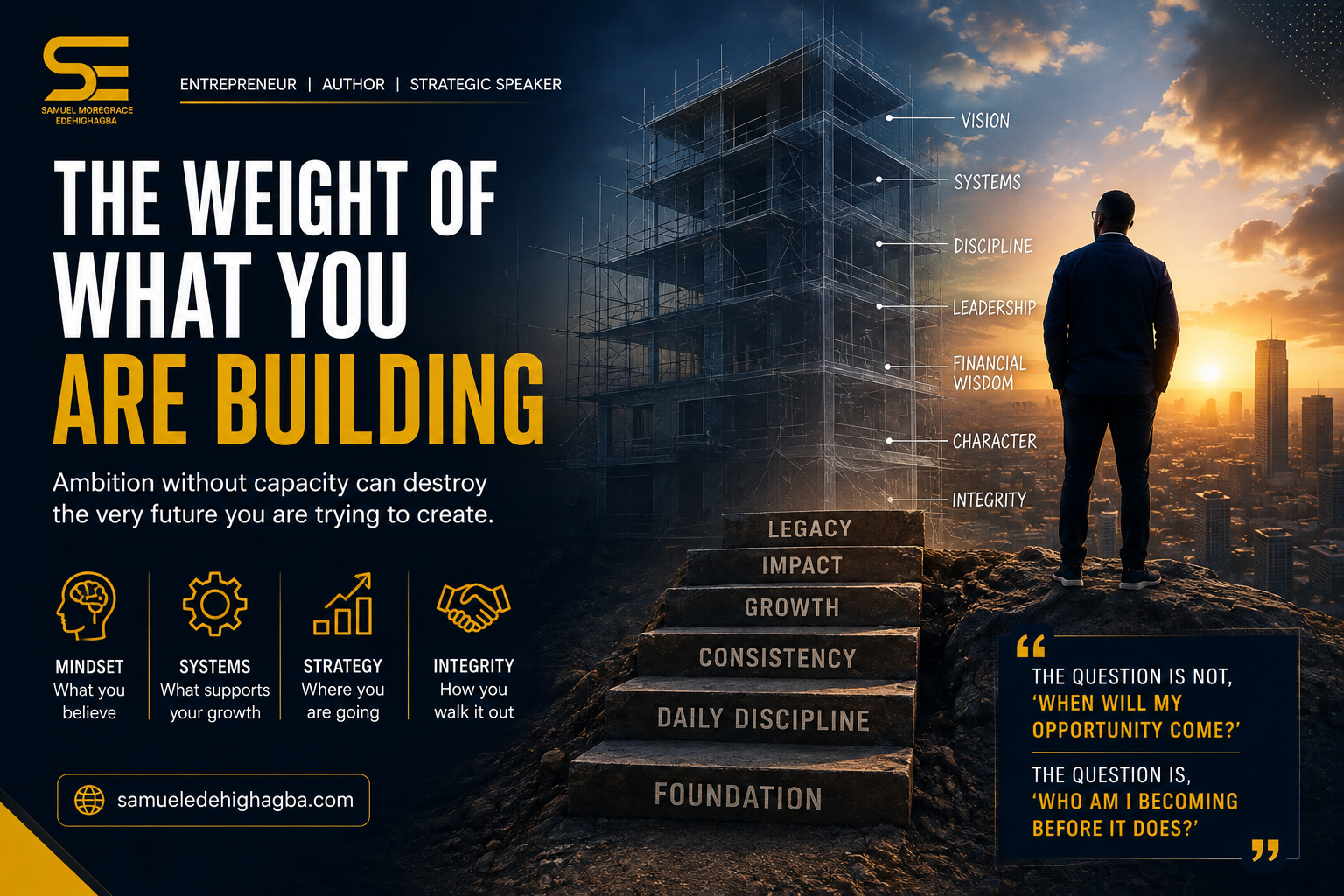
Consider a building. No sensible developer begins by celebrating the number of floors he intends to build. The first question is whether the foundation can carry the structure. The higher the building, the deeper the foundation must go.
I believe human beings are not very different. The height of what you want to build must eventually be matched by the depth of who you are becoming.
If your ambition grows but your discipline does not grow, you create a dangerous gap. If your revenue grows but your financial intelligence does not grow, you create another gap. If your company grows but your leadership remains underdeveloped, eventually that gap will become visible.
And when pressure comes, the cracks usually appear where the capacity was weakest.
Growth Does Not Remove Problems. It Introduces More Sophisticated Problems.
This is one of the things entrepreneurship has taught me. Many people believe, "When I finally grow, my problems will disappear." I do not think that is how it works. Growth changes the nature of your problems. When you have no employees, your problem may be doing everything yourself. When you have employees, your problem may become leadership, accountability and payroll.
When you have no projects, your problem may be finding opportunities. When you have multiple projects, your problem may become cash flow, coordination, quality control and delivery.
When nobody knows your name, your problem may be visibility. When everybody knows your name, your problem may become reputation.
So perhaps the goal is not to build a life without problems. Perhaps the goal is to develop the capacity to solve better and more complex problems. That is what growth really demands. And this is why some people grow quickly and collapse. Their opportunities grew faster than their ability to manage the consequences of growth.
Aliko Dangote Did Not Build an Empire in One Transaction
Let’s take Aliko Dangote as our first case study to portray this point, people look at Aliko Dangote today, they see scale. They see cement plants, manufacturing, logistics and one of Africa's most recognisable business empires.
But large institutions are rarely built by beginning at the largest level. They are built through stages of learning, reinvestment, relationships, systems and increasing complexity.
That is an important lesson for entrepreneurs. Sometimes we look at the finished empire and become impatient with our current stage. We want the outcome without respecting the process that develops the capacity to sustain the outcome.
But you cannot skip every stage and expect to possess the wisdom those stages were designed to teach.
Every level has something to teach. The small deal teaches discipline. The difficult customer teaches patience. The failed transaction teaches due diligence. The wrong employee teaches leadership. The cash-flow crisis teaches financial management. The betrayal teaches discernment. The setback teaches resilience.
The question is whether you are learning. Because experience alone does not automatically create wisdom. Reflection does.
Two people can go through the same problem. One becomes bitter. The other becomes better. The difference is often what they did with the lesson and how the choose to respond to it.
Strive Masiyiwa and the Capacity to Stay in the Fight
The story of Strive Masiyiwa also offers an important lesson about building. Entrepreneurship is not only about having a good idea. Sometimes it is about having the capacity to endure the resistance that comes with trying to bring the idea to life.
There are entrepreneurs who quit because the first obstacle convinces them they chose the wrong path. And there are those who learn, adapt, fight the necessary battles, change strategy and continue building.
This does not mean every entrepreneur should stubbornly hold onto every idea. Sometimes wisdom requires walking away. But there is a difference between strategic adjustment and emotional surrender.
One asks, "What must change for this to work?" The other says, "This is difficult, therefore it cannot work."
Capacity includes the ability to distinguish between the two. Can you remain emotionally stable when things do not go according to plan? Can you make decisions when you are disappointed? Can you separate a bad outcome from a bad future?
These questions matter because entrepreneurship will eventually test not only your intelligence, but your emotional capacity.
Mo Ibrahim and the Discipline of Building Beyond Yourself
Another powerful lesson can be found in the journey of Mo Ibrahim. One of the great transitions in entrepreneurship is moving from simply creating value personally to building an organisation, and eventually thinking about what outlives you.
That transition requires a different kind of capacity.
You cannot build an institution if every important decision must pass through your emotions. You cannot scale if every employee is waiting for you to tell them what to do. You cannot attract serious partners if everything exists only in your head. You cannot build continuity if the company cannot function without your daily physical presence.
This is a lesson I am personally confronting as I think about the future of Samyaotse. I do not want to build a company that looks successful only when I am physically present. I want to build systems. I want people to understand their responsibilities. I want processes that can be improved. I want financial discipline. I want governance. I want the company to become larger than the founder.
But wanting that future requires me to become a different kind of leader. That is the part many entrepreneurs do not want to talk about. The company you are trying to build may require a version of you that does not yet exist. And that version of you must be developed deliberately.
The Scriptures Show Us That Capacity Often Comes Before Assignment
The Bible repeatedly illustrates a pattern that is easy to miss. The promise may come early. But the preparation takes time.
David was anointed before he was ready to reign. He did not immediately sit on the throne. Between the oil and the throne was a process. There were battles. There were caves. There was leadership under difficult conditions. There was rejection. There was waiting.
The promise revealed the destination. But the process developed the person.
Imagine David becoming king without developing the wisdom, patience, courage and leadership that the journey demanded. Perhaps the years between the promise and the palace were not wasted years. Perhaps they were capacity-building years.
That raises an important question for all of us: what if the season you are trying to escape is developing something you will need in the future you are praying for?
Joseph had a dream, but the dream was not enough. He saw the dream long before he entered the palace. But between the dream and the position came betrayal, slavery and prison. Those experiences were painful, but they also exposed Joseph to responsibility and administration. By the time Egypt needed someone capable of managing an economic crisis, Joseph was not merely a man with a dream. He had become a man with administrative capacity.
That distinction is important. Many people have dreams. Few are preparing themselves to manage what those dreams require. You may be praying for influence. Are you learning how to communicate? You may be praying for wealth. Are you learning financial discipline? You may be praying for employees. Are you becoming a better leader? You may be praying for expansion. Are you building systems?
A dream may show you where you are going. But capacity determines what happens when you arrive.
The Most Dangerous Question Is Not "When Will My Opportunity Come?"
Perhaps the deeper question is: what will happen if my opportunity comes tomorrow? Would you be ready?
If someone invested GH₵10 million into your business tomorrow, what system would receive the money? Who would account for it? Who would approve expenditure? What controls would prevent abuse? What reporting system would tell you whether the investment was producing results?
If you suddenly received one thousand new customers, could your current system serve them?
If your company doubled in size next year, could your leadership style sustain it?
These are not negative questions. They are questions of preparation. Sometimes we spend so much time praying for the door to open that we forget to prepare ourselves for what is on the other side.
Capacity Has Dimensions
Allow me to raise this debate that capacity is not simply intelligence. A person can be brilliant and still be incapable of managing growth. I believe capacity has several dimensions.
1. Mental Capacity — Can you think beyond today's emergency? Can you move from reacting to planning? Can you see consequences before making decisions?
2. Emotional Capacity — Can you remain stable when things go wrong? Can you receive criticism? Can you lead without allowing every disappointment to change your direction?
3. Financial Capacity — Can you distinguish between revenue and profit? Can you protect operating cash? Can you delay gratification? Can you say no to an opportunity that does not make financial sense?
4. Leadership Capacity — Can you build people? Can you delegate? Can you hold people accountable without destroying relationships? Can you create a culture that survives your absence?
5. Operational Capacity — Do you have systems? Are your processes documented? Can the organisation function beyond memory and improvisation?
6. Moral Capacity — What happens when you finally have power? Can you remain honest when dishonesty becomes profitable? Can you protect trust when nobody is watching?
7. Spiritual Capacity — Can your character survive the success your ambition is pursuing? Because success does not automatically improve character. Sometimes it simply gives character more resources to express itself.
What My Journey Is Still Teaching Me
I do not write this article as someone who has mastered all these lessons. I write it as someone who is still being taught by the weight of what he is trying to build.
Samyaotse has given me dreams. But it has also given me lessons.
There have been times when I believed more capital was the answer, only to realize that capital without the right system can disappear faster than expected. There have been times when I thought having more people would solve the workload, only to discover that more people without accountability can create more problems.
There have been times when the pressure of survival made immediate opportunities look attractive, even when a more strategic approach was necessary. And that is perhaps one of the greatest transitions I am personally trying to make: from survival to strategy.
Survival asks, "How do I solve today's problem?" Strategy asks, "What system can prevent this problem from controlling me again?"
Survival reacts, strategy prepares, survival spends to escape pressure, strategy allocates resources deliberately, survival depends on the strength of the founder, strategy builds an organization capable of functioning beyond the founder.
That transition is not easy. But I believe it is necessary.
A Moment of Self-Examination
Before you continue asking for more, perhaps pause and ask yourself: If my business doubled tomorrow, would I be able to manage it? If I received the capital I have been praying for, would I know exactly what to do with it? If I employed ten people tomorrow, would I have the leadership systems to manage them? If I received one thousand customers, would my service improve or collapse? Am I building systems, or am I simply becoming busier? What problem keeps repeating in my life or business because I have not built the capacity to solve it permanently? Am I blaming external circumstances for a weakness I should be developing internally?
What is my current level trying to teach me?
And perhaps the most difficult question: am I truly ready for what I keep saying I want?
Before You Build Bigger, Build Deeper
I still believe in ambition. I still believe in building businesses. I still believe in wealth creation. I still believe in expansion.
But I am learning that bigger is not always better if deeper has been neglected.
A bigger business with weak systems is a bigger risk. More money with poor discipline is a bigger problem. More employees with weak leadership is greater chaos. More opportunities without discernment can lead to more expensive mistakes.
So perhaps, before we ask how high we can go, we should ask how deep we are willing to grow. Because a building can only rise safely when its foundation is prepared to carry its weight. The same may be true of our ambitions. Do not only ask for a bigger opportunity. Build a bigger capacity. Do not only pray for more responsibility. Become more responsible. Do not only desire wealth. Develop the discipline required to manage it. Do not only build a business. Build the person capable of leading it.
And perhaps that is one of the greatest lessons of entrepreneurship: the future you are trying to build will eventually demand more from you than the version of you that started the journey. The question is not whether the opportunity will come. The question is: who will you become before it does? Because opportunities can open doors. But capacity determines whether you can remain in the room.
And sometimes, the greatest investment you can make in the business you are building is not another property, another employee or another project.
Sometimes, the greatest investment is becoming the person capable of carrying the weight of what you are building.
About the Author
Samuel Moregrace Edehighagba is an entrepreneur, author, strategic speaker, and the Founder & CEO of Samyaotse Company Limited. Through his writing, speaking engagements, and The CEO Perspective Podcast, he equips entrepreneurs and professionals with practical insights on leadership, wealth creation, business strategy, and personal development. His mission is to help people move from survival to strategy by building businesses, assets, and legacies that outlive them.