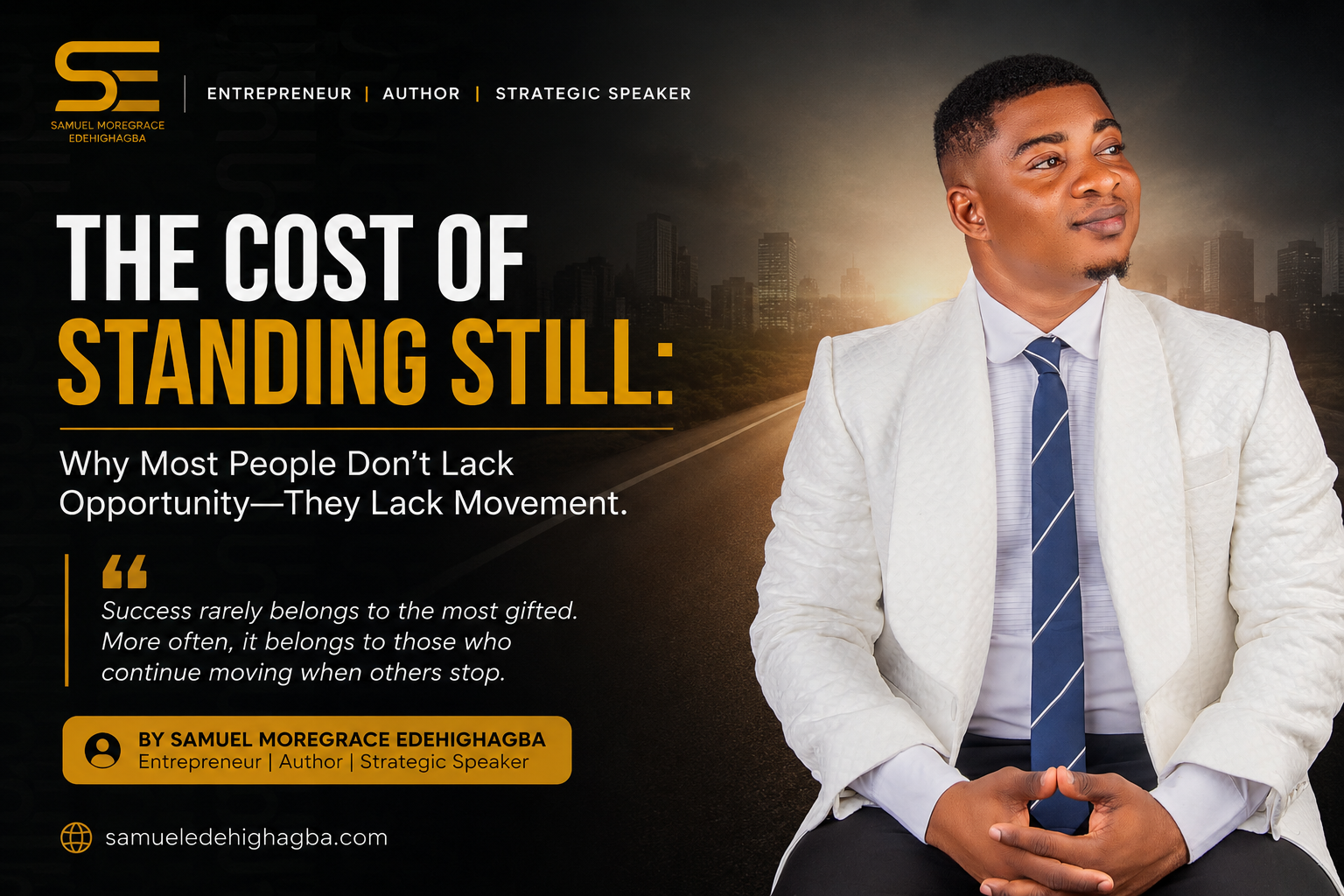
The Cost of Standing Still: Why Most People Don't Lack Opportunity—They Lack Movement
"Success rarely belongs to the most gifted. More often, it belongs to those who continue moving when others stop."
Introduction
One of the greatest misconceptions about success is the belief that opportunities are distributed unfairly, that some people simply receive better chances than others. While opportunities certainly differ, I have come to believe that the greater difference lies in how people respond to them.
Throughout my entrepreneurial journey, I have met highly educated professionals who remain financially stagnant, alongside individuals with little formal education who have built remarkable businesses. I have encountered people with brilliant ideas who never acted on them, while others with ordinary ideas achieved extraordinary results simply because they kept moving. This observation led me to ask a difficult question:
Do most people really lack opportunity, or have they become comfortable standing still?
For years, I believed success was primarily about intelligence, capital, and timing.
Today, I see things differently. Success is often less about having perfect conditions and more about maintaining consistent movement despite imperfect conditions.
The greatest tragedy is not failure. It is unrealized potential.
Movement Is One of Life's Greatest Principles
Everything in creation moves. The earth rotates. The seasons change. Rivers flow.
Seeds grow. Life itself is sustained by movement. Only things that have died remain permanently still. The same principle applies to personal growth and entrepreneurship. Progress requires movement. When movement stops, growth eventually stops. Many people spend years waiting for certainty before taking action. Unfortunately, certainty rarely arrives before commitment. Instead, clarity often emerges while we are already moving. One lesson entrepreneurship continues to teach me is this:
Movement creates information that planning alone never can.
No business plan can predict every challenge. No strategy can eliminate every risk.
Some lessons can only be learned through experience.
My Journey: When Standing Still Was Never an Option
There was a season in my entrepreneurial journey when almost everything seemed uncertain. Projects slowed. Cash flow became inconsistent. Every decision felt heavier than the one before. Like many entrepreneurs, I questioned myself. Should I continue investing? Should I slow down? Should I wait until circumstances improved? Looking back today, I realize that those questions were not simply about business. They were questions about identity. Would I become someone who waits for better conditions, or someone who builds despite them? That season taught me something profound:
“Momentum is often built in seasons when nobody can see your progress”.
The articles you write. The conversations you have. The relationships you nurture.
The lessons you learn. The discipline you maintain. These are movements that eventually become visible as success.
Why People Stop Moving
From years of observation, I believe most people become stagnant for four reasons.
1. They Wait Until They Feel Ready
Many people mistakenly believe confidence comes before action. The opposite is often true. Confidence grows because of repeated action. The entrepreneur who confidently negotiates today was once afraid to make a simple sales call. The public speaker who inspires thousands was once nervous speaking before ten people. Nobody begins with confidence. They develop confidence through movement.
As James Clear writes in Atomic Habits:
"Every action you take is a vote for the type of person you wish to become."
Identity is not built by intention alone. It is built through repeated action.
2. They Confuse Planning with Progress
Planning is important. Strategy is essential. But planning without execution eventually becomes procrastination wearing professional clothes. I've met entrepreneurs who have revised business plans for years. They attended conferences. Purchased courses. Read books. Yet never launched. Knowledge creates possibilities. Execution creates outcomes.
Peter Drucker famously observed:
"The best way to predict the future is to create it."
Creation demands action.
3. They Fear Imperfection
Perfection has delayed more dreams than failure. Many entrepreneurs never launch because they fear criticism. Ironically, improvement rarely happens before launch.
It happens after feedback. The first version is rarely the final version. Progress belongs to those willing to improve publicly.
4. They Mistake Comfort for Security
Comfort feels safe. Growth rarely does. Every meaningful opportunity requires stepping beyond familiar territory. History consistently demonstrates that innovation belongs to those willing to embrace uncertainty. The question is not whether uncertainty exists. The question is whether uncertainty will become your excuse.
Opportunity Is Often Hidden Inside Movement
Many people believe opportunity arrives first. My experience suggests something different. Movement often creates opportunity. One conversation introduces another. One article leads to an invitation. One client refers another. One decision changes an entire career. The opportunity wasn't waiting. It was created through consistent movement.
The Compound Effect of Daily Decisions
People often overestimate what they can accomplish in one month. They underestimate what consistent action can accomplish over five years. Success compounds. Knowledge compounds. Relationships compound. Trust compounds.
Discipline compounds. Small daily decisions eventually produce extraordinary outcomes.
As Darren Hardy explains in The Compound Effect, success is rarely the result of dramatic breakthroughs. More often, it is the cumulative outcome of small, consistent choices made over time. That perspective changed the way I build businesses.
Three Questions Worth Asking Yourself
As you begin this month, pause and reflect:
- What decision have I delayed because I'm waiting to feel ready?
- What opportunity have I ignored because I fear failure more than stagnation?
- What one meaningful action can I take this week that my future self will thank me for?
Remember:
Your future is not shaped by what you intend to do. It is shaped by what you repeatedly do.
Final Thoughts
The marketplace does not reward potential. It rewards value. Value is created through movement. Movement produces experience. Experience produces wisdom.
Wisdom produces better decisions. Better decisions produce better outcomes. So wherever you find yourself today, don't wait for perfect conditions. Start where you are. Use what you have. Keep moving. Because one day, someone will call you successful without realizing that your greatest achievement was simply refusing to stand still. Keep building. Keep learning. Keep moving.
About the Author
Samuel Moregrace Edehighagba is an entrepreneur, author, strategic speaker, and the Founder & CEO of Samyaotse Company Limited. Through his writing, speaking engagements, and The CEO Perspective Podcast, he equips entrepreneurs and professionals with practical insights on leadership, wealth creation, business strategy, and personal development. His mission is to help people move from survival to strategy by building businesses, assets, and legacies that outlive them.
References
Clear, J. (2018). Atomic Habits: An Easy & Proven Way to Build Good Habits & Break Bad Ones. Avery.
Drucker, P. F. (2006). The Effective Executive. Harper Business. (Original work published 1967).
Hardy, D. (2010). The Compound Effect. Vanguard Press.
Maxwell, J. C. (2007). The 21 Irrefutable Laws of Leadership. Thomas Nelson.
Proverbs 16:3 (New International Version). "Commit to the Lord whatever you do, and he will establish your plans."
Ecclesiastes 11:4 (New International Version). "Whoever watches the wind will not plant; whoever looks at the clouds will not reap."